There is no single best month
The Serengeti is open all year. What changes is where the herds are and how much rain falls. Calving in the south and river crossings in the north are separate highlights, months apart. Pick the one you care about, then choose the region and the month that go with it.
Monthly herd positions below are typical patterns, not a timetable. Weather can move the herds, and nobody can promise a sighting or a crossing on a given day. Operators describe the seasons in slightly different ways, and where they differ, both views are shown.
Rainy and dry seasons
Typical patterns. They are not a weather forecast.
Short rains: November and December
Shorter rainfalls are typical in these two months. The herds move south and return to the short-grass plains by December.
Long rains: March to mid-May
The heavier rains fall in this period, when the herds spread out and start to move north. Some camps close for part of it.
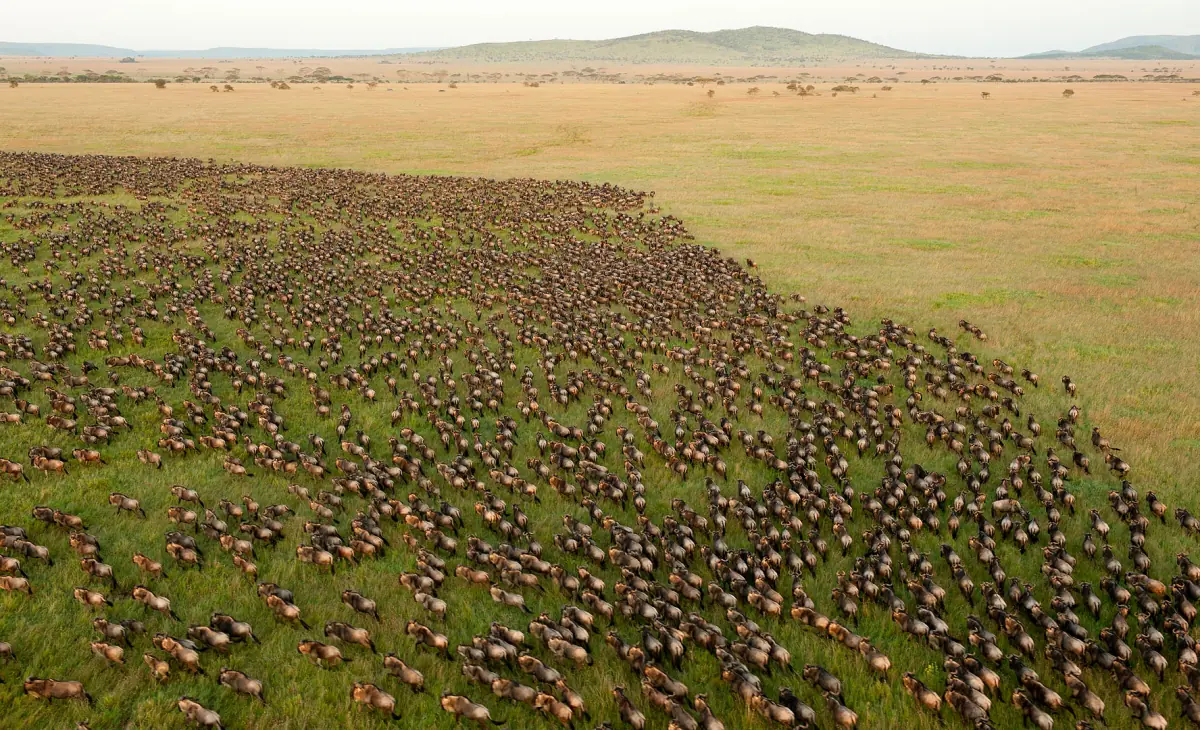
Dry season: about June to October
This is the usual window for the western and northern parts of the migration. A simpler two-season split counts November to April as rainy and May to October as dry.
May is a transition month
Some descriptions put the end of the long rains in mid-May, others already count May as dry. Treat May as a month in between, and ask your camp about current conditions.
Serengeti safaris by season
Guided Serengeti safaris, game drives and multi-day trips, with live prices and availability. Check the dates against the season you want.
Month by month: where the herds typically are
Typical area and rain pattern. Individual years differ.
| Month | Typical area of the herds | Rain pattern |
|---|---|---|
| January | Short-grass plains in the south | – |
| February | Southern short-grass plains | – |
| March | South, Loliondo and the Ngorongoro Conservation Area, spread over a wider area | Long rains begin |
| April | Moving north past Moru and Seronera | Long rains |
| May | From Seronera toward the Western Corridor | Long rains end around mid-May |
| June | Gathering in the Western Corridor and the Grumeti area | Mostly dry |
| July | Grumeti and the Grumeti Reserve; first arrivals in the north are possible | Dry |
| August | Farther into the far northwest | Dry |
| September | Northern Serengeti and the Maasai Mara | Dry |
| October | Far north and the Mara | Dry |
| November | Moving south over Loliondo and the eastern edge | Short rains |
| December | Return to the southern short-grass plains | Short rains |
Other descriptions have herds gathering in the north from late June and in the south from late December. All of these are typical patterns, so do not read any of them as a fixed calendar. The Great Migration page explains the movement in more detail.
Choose by what you want to see
Each goal points to a region and a window.
Calving season
January to March is the guide, with the peak usually in February and the season fading in early March. The calving area lies in the south. Ndutu Safari Lodge sits in the Ngorongoro Conservation Area, not in the national park. Read about Ndutu in the conservation area.
Calving season →Grumeti and the west
The Grumeti River in the west fits roughly June and July. It is a different river stretch from the Mara, so not every crossing is a Mara River crossing.
Mara River crossings
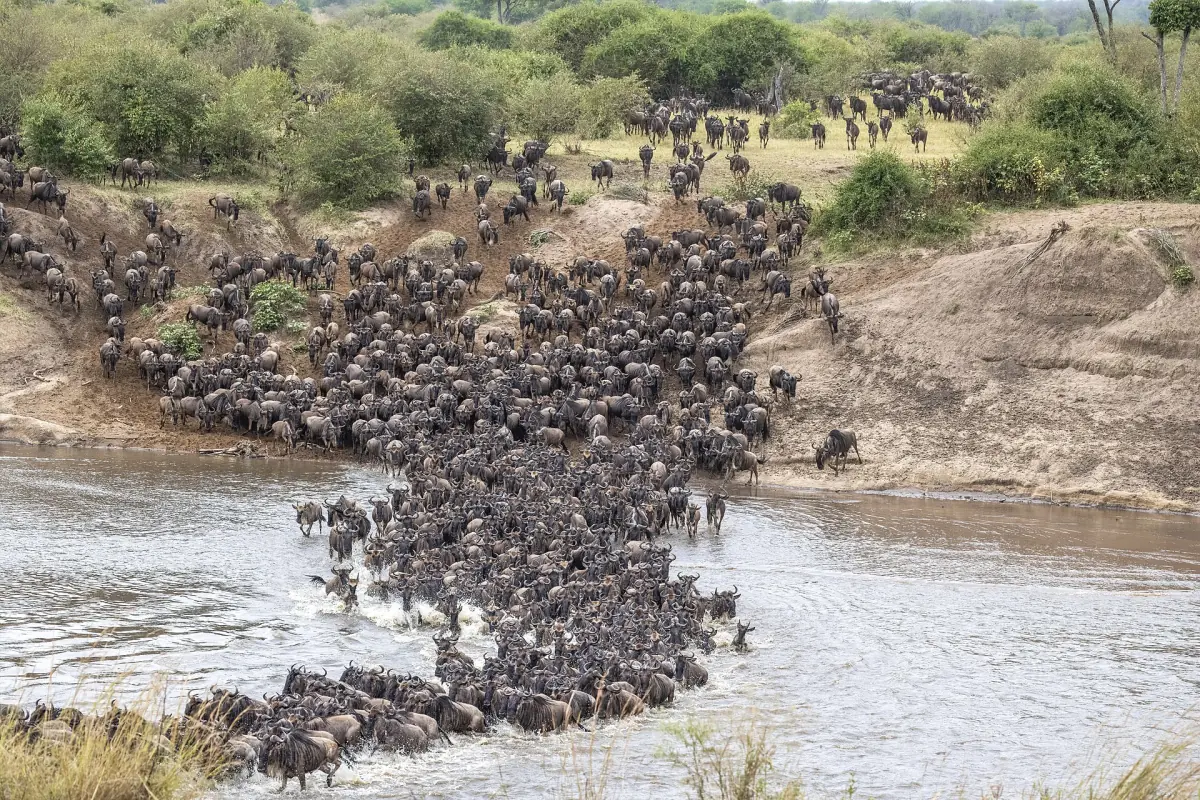
The northern Serengeti sees crossings roughly from July to October, often with a start around mid-July. Crossings do not happen every day, and no time or place is guaranteed.
Mara River crossings →Planning around the seasons
A few things to know before you plan.
Camps close, the park does not
The park is open all year, but some camps close. Sayari Camp in the north is open from June to March and closed in April and May. Ubuntu Migration Camp moves with the herds: north (Lamai Wedge) from June to mid-November, south (Kusini) from mid-December to mid-March, and it is closed from mid-March to May and from mid-November to mid-December.
Book early in peak months
Book early for the busiest months, and check the distance to the gate, transfers and meals. See where to stay.
Fees have seasons too
The park tariff has used a different rate between 15 March and 15 May, and concession fees have used different rates for July to September and for October to June. Check the current figures on the park fees page.
Best time to visit the Serengeti: frequently asked questions
What is the best month to visit the Serengeti?
It depends on the goal. February suits calving in the south, July to October suits crossings in the north, and June to October is roughly dry. No month guarantees a specific sighting.
When is the dry season?
It is about June to October in most descriptions, and a simpler split counts May to October. May is a transition month between the two.
When are the rains?
Short rains are typical in November and December. Long rains fall from March to about mid-May. A simpler split counts the whole stretch from November to April as rainy.
When can I see the river crossings?
Mara River crossings in the north usually fall roughly between July and October. They are not daily and not scheduled, so plan several days in the north if crossings matter to you.
Is the Serengeti open in the rainy season?
Yes. The park is open all year and the gate closes at 18:00. Some camps close for part of the rainy months, so check your camp.
Can I see the herds in any month?
The herds move through the year, so the area changes with the month. Use the table to choose a region for your month, and see the wildlife page for the animals you can look for.